 ™
™
Today, we’re launching the Grass Contents API, an API that turns any public URL into clean, model-ready HTML, Markdown, or text.
The Contents API is built using the Grass Network and designed to retrieve pages that conventional web infrastructure struggles to access.
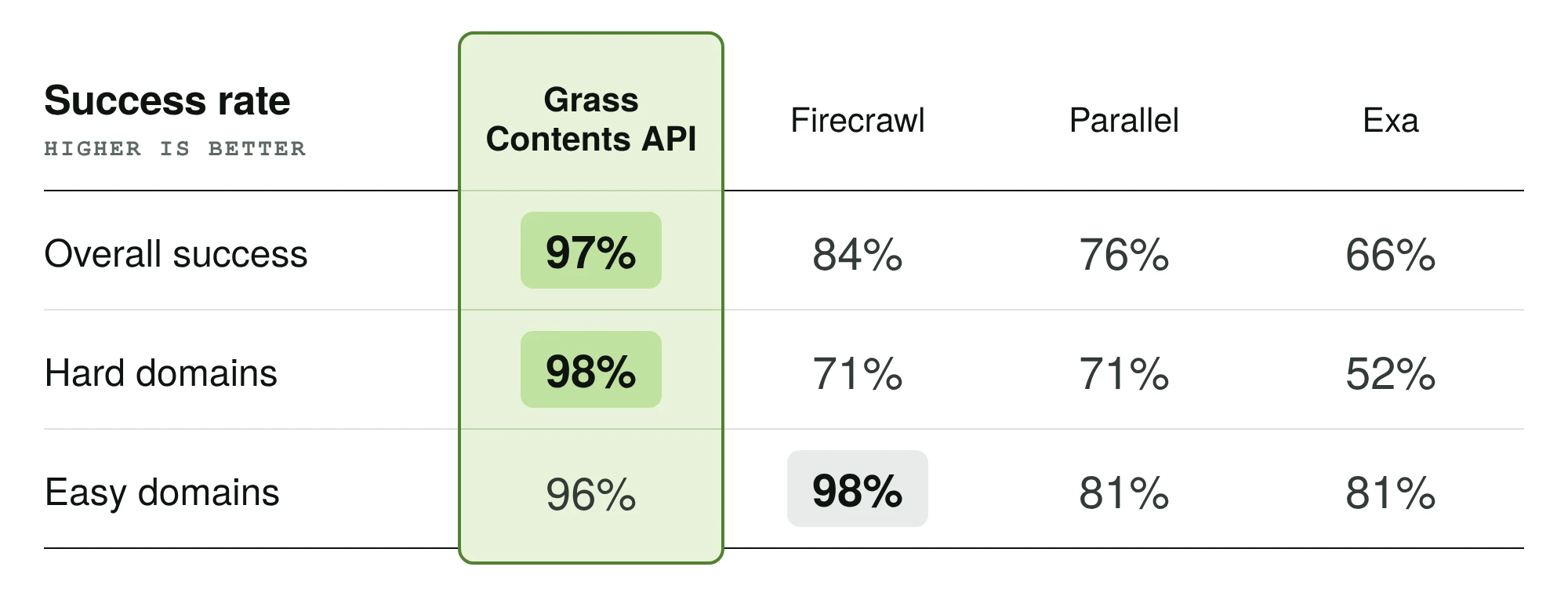
In our latest benchmark, Grass successfully retrieved 98% of pages in our hard-domain test set, compared to 71% for the next-best provider. Across the full benchmark, Grass successfully retrieved content from 97% of URLs, compared to 84% for Firecrawl, 76% for Parallel, and 66% for Exa.
On priority domains, such as e-commerce sites, social media, and job boards, Grass was the only provider tested with a 100% success rate.
The Contents API also renders Javascript, supports geo-targeted requests and freshness controls, and is capable of automatically stripping unnecessary HTML elements for token efficiency.
Current plans support between 2 and 20 requests per second, with higher dedicated capacity available for custom deployments.
Live Context Retrieval Benchmark Methodology
We built the benchmark around a simple question: when an agent asks for fresh content from a URL, can the provider actually retrieve it?
On October 1, 2026, we tested Grass against Firecrawl, Parallel, and Exa across 100 public web destinations. Every request was made in forced-fresh mode, with caching disabled wherever the provider exposed that control.
The benchmark included both relatively accessible pages and a deliberately difficult set spanning e-commerce, social platforms, news, Cloudflare-protected sites, JavaScript-heavy pages, and other websites that frequently present problems for automated retrieval.
The results:
Latency on like-for-like domains
Latency needs to be interpreted alongside coverage. Generally, latency skews much higher for more difficult sites, which would make it unfair to compare average request latency when some providers are unable to return content at all on harder URLs.
To make the comparison like-for-like, we separately measured latency across the 50 URLs that all four providers successfully retrieved.
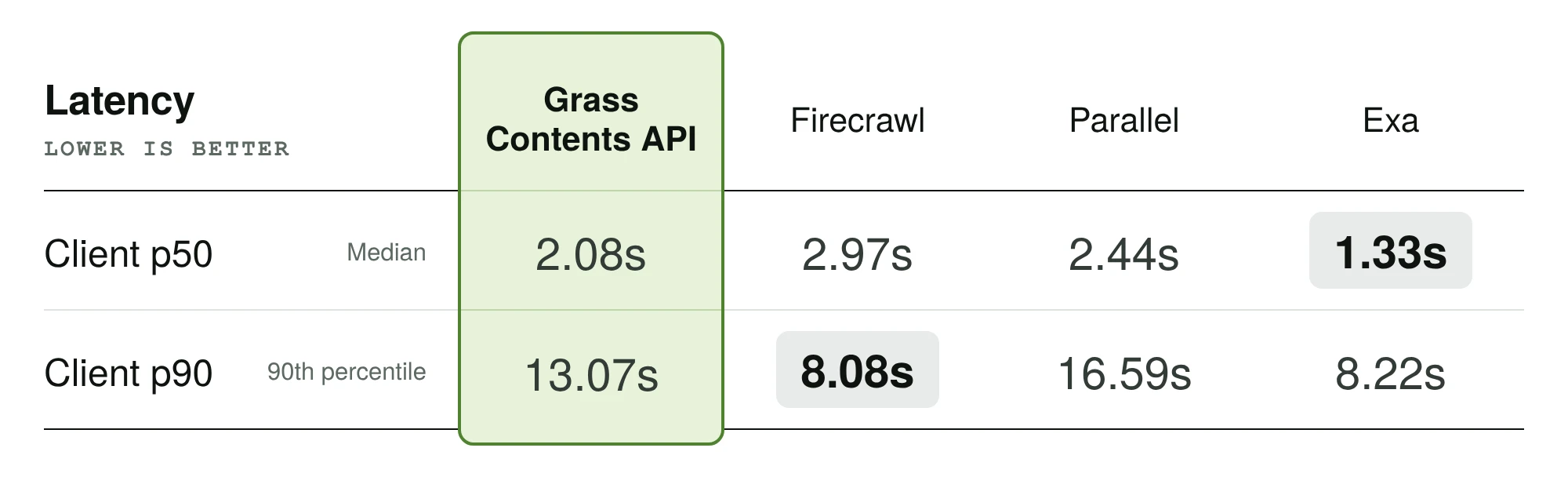
On this common-success set, Grass had a median client latency of 2.08 seconds, faster than Firecrawl and Parallel, but behind Exa.
How it works
Each request moves through a series of increasingly capable retrieval paths depending on what the target URL requires.
For straightforward pages, Grass uses lightweight retrieval designed to return content with minimal latency. If that fails, the request can fall back to our proprietary retrieval infrastructure. When this isn’t enough, Grass can escalate to a full browser environment to render JavaScript, interact with dynamic page behavior, and return the resulting content.
Motivation
AI models are increasingly capable of using live information, but much of the public web is difficult for them to access reliably.
For most agentic applications, reading the live state of the web is a critical process as access to information is essential to AI model performance. We have built the Contents API to support consistent and cost-efficient access to the information that AI models require to operate.
Try the Contents API
You can register for access to the Grass Contents API at lcr.net. Requests will be reviewed to confirm all requirements for access are met as the Contents API relies upon bandwidth sourced from the Grass Network to operate. Grass takes privacy and security seriously, and is taking steps to ensure that only verified users are provided with access to the Contents API.